How to Choose the Perfect Towing Setup for Your Rig


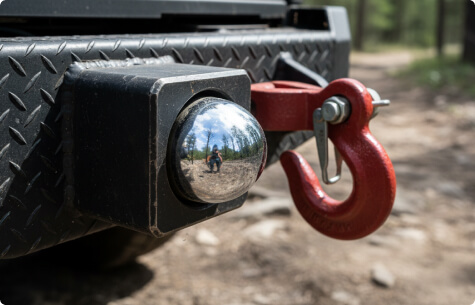
A towing setup is a system, not a single part. The hitch, the ball mount, the wiring, the brake controller and the suspension all have to work together, and the weakest link sets the limit. Get one piece wrong and you can end up with a trailer that sways, a truck that squats, or brakes that cannot keep up on a long downhill grade.
Here is how we think through a towing setup, step by step, before anything gets bolted on.
Start with your truck's ratings, not the trailer
Every towing decision starts with numbers your manufacturer already published. Look in your owner's manual and on the door-jamb sticker for these:
- GVWR (Gross Vehicle Weight Rating): the most your truck can weigh fully loaded, including passengers, cargo and tongue weight.
- GCWR (Gross Combined Weight Rating): the most the truck and trailer can weigh together.
- Payload: what the truck can carry in the cab and bed. Tongue weight counts against payload.
- Maximum tow rating: the advertised number, which is often calculated with a lightly equipped truck and one driver.
Ratings vary by engine, axle ratio, cab, bed length and factory tow package, so two trucks that look the same can have very different limits. Always use the numbers for your exact truck.
Know your trailer's real weight
The weight printed on a trailer brochure is usually the dry weight. Once you add fuel, water, gear, a side-by-side or a load of mulch, the number climbs fast. If you can, weigh the loaded trailer at a public scale.
A good rule of thumb for conventional bumper-pull trailers is a tongue weight of roughly 10 to 15 percent of the loaded trailer weight. Too little tongue weight is a common cause of sway. Too much overloads the rear axle and lightens the front end, which hurts steering and braking.
Pick the right hitch class
Receiver hitches are grouped into classes by capacity and receiver size. In general terms:
- Class I and II: light-duty, usually a 1-1/4 inch receiver, for small trailers and bike racks.
- Class III: the common 2-inch receiver found on many half-ton trucks and SUVs.
- Class IV: heavier-duty 2-inch receivers for larger trailers.
- Class V: commercial-grade, often 2-inch or 2-1/2 inch, for heavy equipment and big campers.
Your towing capacity is the lowest rating among the truck, the hitch, the ball mount, the ball and the trailer coupler. A heavy-duty hitch does not raise your truck's rating.
Ball mounts and drop
The trailer should ride level, or very close to it. Measure from the ground to the top of your receiver opening, then from the ground to the bottom of the trailer coupler while the trailer sits level. The difference tells you how much drop or rise your ball mount needs. Lifted trucks often need a large-drop mount to keep the trailer level.
Match the ball diameter to the coupler (commonly 1-7/8, 2 or 2-5/16 inch) and make sure the ball's rating meets or exceeds the load.
Gooseneck and fifth-wheel options
For heavy campers, livestock trailers and equipment haulers, many owners step up to an in-bed gooseneck or fifth-wheel hitch. These put the load over or just ahead of the rear axle, which tends to improve stability with heavy trailers. They do take up bed space and add weight, so plan around how you use the truck the rest of the week.
Weight distribution and sway control
On heavier bumper-pull trailers, a weight-distribution hitch uses spring bars to shift some tongue weight forward to the front axle and back to the trailer axles. That helps restore steering feel and level the rig. Many systems also include sway control. Your truck's manual may specify when weight distribution is required, so check it.
Brakes, wiring and lighting
Many trailers above a certain weight have electric brakes, and they need a brake controller in the truck to work. A proportional brake controller applies trailer brakes in step with how hard you are stopping, which feels smoother on mountain grades.
For wiring, a 4-pin connector handles basic lights. A 7-way connector adds brake signal, reverse and 12-volt power. Make sure your connector and your trailer match, and test every light before each trip. Trailer brake requirements vary by state and trailer weight, so check Tennessee rules and any state you plan to tow through.
Suspension support
If your truck squats noticeably when the trailer is hitched, the setup may need help. Options include airbag helper springs, upgraded shocks and add-a-leaf kits. Air springs let you adjust support to the load. Remember that suspension upgrades improve ride and level, but they do not increase your GVWR, payload or tow rating.
Getting a towing setup done in Knoxville
Towing is one of the core categories at Phoenix Conversions, and our team can help you match hitch, mount, wiring and suspension parts to your truck and trailer. Our showroom and install shop sits right off I-40 at Exit 383 at 5915 Casey Drive in Knoxville. We also carry Air Lift Performance, so ask about air suspension options for your truck. Bring your trailer specs, or call 865-670-4060 to request a quote. If you are driving in from Chattanooga, the Tri-Cities or Nashville, call ahead so we can confirm parts and set up your install.
Frequently asked questions
How much tongue weight should my trailer have?
For most conventional bumper-pull trailers, plan on roughly 10 to 15 percent of the loaded trailer weight. Check your truck's owner's manual and your trailer maker's guidance for your specific setup.
Does a bigger hitch increase my towing capacity?
No. Your safe towing limit is the lowest rating among the truck, hitch, ball mount, ball and coupler. The truck's own ratings, found in the owner's manual, always set the ceiling.
Do I need a brake controller?
If your trailer has electric brakes, you need a brake controller in the truck for those brakes to work. Requirements for trailer brakes vary by state and trailer weight, so check the rules where you tow.