Fleet Upfitting Checklist for Tennessee Contractors


For a contractor, a work truck or van is not just transportation. It is the tool that carries every other tool. A smart upfit helps crews find parts faster, carry what they need to finish the job in one trip, and keep equipment protected. A poorly planned upfit wastes space, overloads the vehicle and slows everyone down.
Use this checklist when planning upfits for one vehicle or a whole fleet.
1. Define the job each vehicle does
- What trade or service is the vehicle used for?
- How many techs ride in it?
- Does it serve residential calls, commercial job sites or both?
- Does it tow a trailer or carry equipment?
- Does it need to fit in garages, parking decks or tight neighborhoods?
The answers decide whether the right platform is a cargo van, a pickup with a service body, a cab-chassis with a flatbed or something else.
2. Inventory what rides along
List every tool, part, ladder and piece of equipment the vehicle carries on a normal day. Then group them:
- Small parts that need bins and drawers.
- Tools and meters that need secure, protected storage.
- Long stock like pipe, conduit and ladders.
- Heavy or bulky items like pumps, compressors and coils of wire.
3. Check payload and ratings
This is the step most often skipped. Find the vehicle's GVWR and payload in the owner's manual or on the door-jamb sticker. Add up:
- The weight of the upfit itself: shelving, bodies, racks, partitions.
- The crew.
- A full day's inventory and tools.
- Tongue weight, if the vehicle tows.
The total needs to stay under the vehicle's ratings. If it does not, you may need a heavier-duty chassis, lighter equipment or a different load plan. Overloaded vehicles wear faster and can handle and stop poorly.
4. Choose the storage platform
Cargo vans
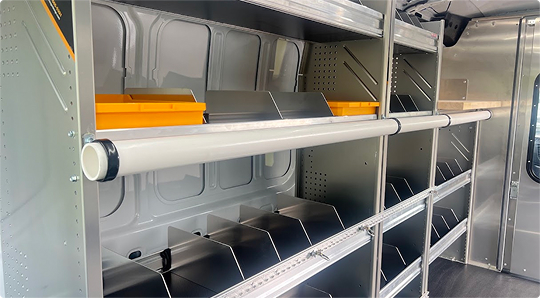
Vans offer secure, weather-protected storage. Shelving, drawer units, bins and partitions from makers like Adrian Steel and Ranger Design are built to fit popular van models.
Service bodies
Service bodies replace a pickup bed with exterior compartments that open from the side. They are popular with plumbers, electricians, HVAC techs and utility crews. Reading is a well-known name in service bodies.
Flatbeds and platform bodies
Flatbeds suit crews hauling pallets, equipment or materials that need to load from the side or with a forklift. CM builds flatbeds and truck bodies for work trucks.
5. Plan ladder and long-item storage
- Drop-down ladder racks lower ladders to a safer working height for loading.
- Fixed racks work for lighter or occasional use.
- Conduit and pipe tubes keep long stock contained and dry.
Measure total height with the rack installed and check it against your shop door and common job-site clearances.
6. Build in safety
- Partitions between the cab and cargo area help keep loose items out of the cab.
- Tie-downs and cargo restraints secure bulky equipment.
- Proper storage for fuel, refrigerant and chemicals per the product labels and any rules that apply to your trade.
- Interior and work lighting for early-morning and evening calls.
- Warning lights where your work requires them; check applicable rules.
7. Standardize across the fleet
When every vehicle in a fleet has the same layout, any tech can grab any truck and know where things are. Restocking gets simpler, inventory checks get faster and training new hires gets easier. Create a simple layout map and stock list for each vehicle type.
8. Think about the brand on the road
A clean, organized work vehicle is a rolling billboard. Plan where graphics or lettering will go so racks and bodies do not cover them.
9. Plan for the vehicle's whole life
Ask whether equipment can be removed and moved to a replacement vehicle later. Modular shelving and some racks can transfer, which can stretch your investment across vehicle replacements.
10. Budget and timing
Plan upfits alongside vehicle purchases so trucks are not sitting idle. For larger fleet projects, talk through scheduling so vehicles can be upfitted in batches without taking too many off the road at once.
Commercial upfitting in Knoxville
Commercial upfitting is one of the core categories at Phoenix Conversions. We carry Adrian Steel, Ranger Design, Reading and CM, and we work with contractors from across Tennessee at our 70,000 square foot showroom and install shop at 5915 Casey Drive in Knoxville, off I-40 at Exit 383. Bring this checklist and call 865-670-4060 or email esales@phoenixconversions.com to request a quote.
Frequently asked questions
What is commercial vehicle upfitting?
Upfitting means adding work equipment such as shelving, service bodies, flatbeds, ladder racks and partitions to a van or truck so it is ready for a specific trade.
How do I know if my upfit will overload my truck?
Add the weight of the upfit, crew, inventory and any tongue weight, then compare the total to the GVWR and payload in your owner's manual.
Should every vehicle in my fleet have the same layout?
Where possible, yes. A standard layout per vehicle type makes restocking, training and swapping vehicles much easier.